
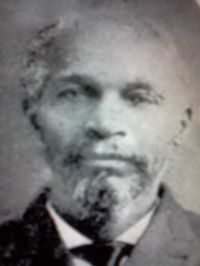
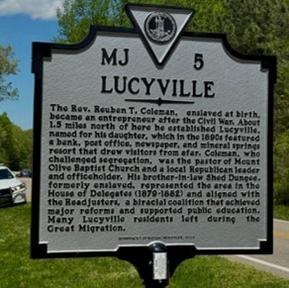
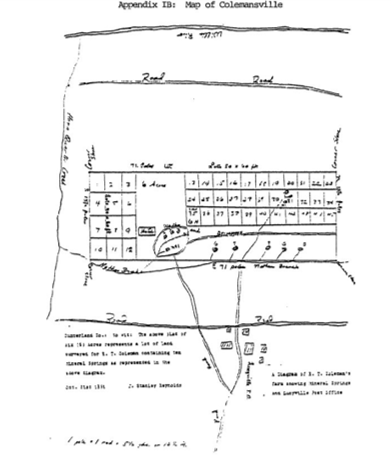
By the mid-1880s Coleman was also one of the county’s principal farmers. A large tract of land that he owned a few miles north of the county courthouse contained about three dozen mineral springs. He developed the property into his largest and most profitable business venture, which increased his community prestige and social standing. On 29 December 1891 he incorporated the Colemanville Mineral Springs Company, of which he became principal stockholder and president, to oversee and manage the springs. He had the water bottled and shipped to stores in several cities. The company also sold town lots and summerhouses to vacationing northerners and southern city-dwellers who bathed in the pools and drank from the mineral springs. People without summer homes could stay in the Colemanville Hotel. The town had its own post office (of which Coleman was postmaster from June 1876 until July 1881), bank, a newspaper entitled the Central Call, and horse 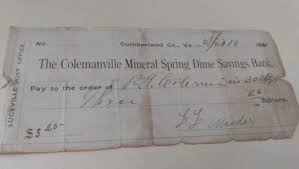 stables. Although the town was called Colemanville during the heyday of the Colemanville Mineral Springs Company, the post office was established as Lucyville, named for a daughter who had died. The management company failed in the early years of the twentieth century, and the post office closed about the same time.
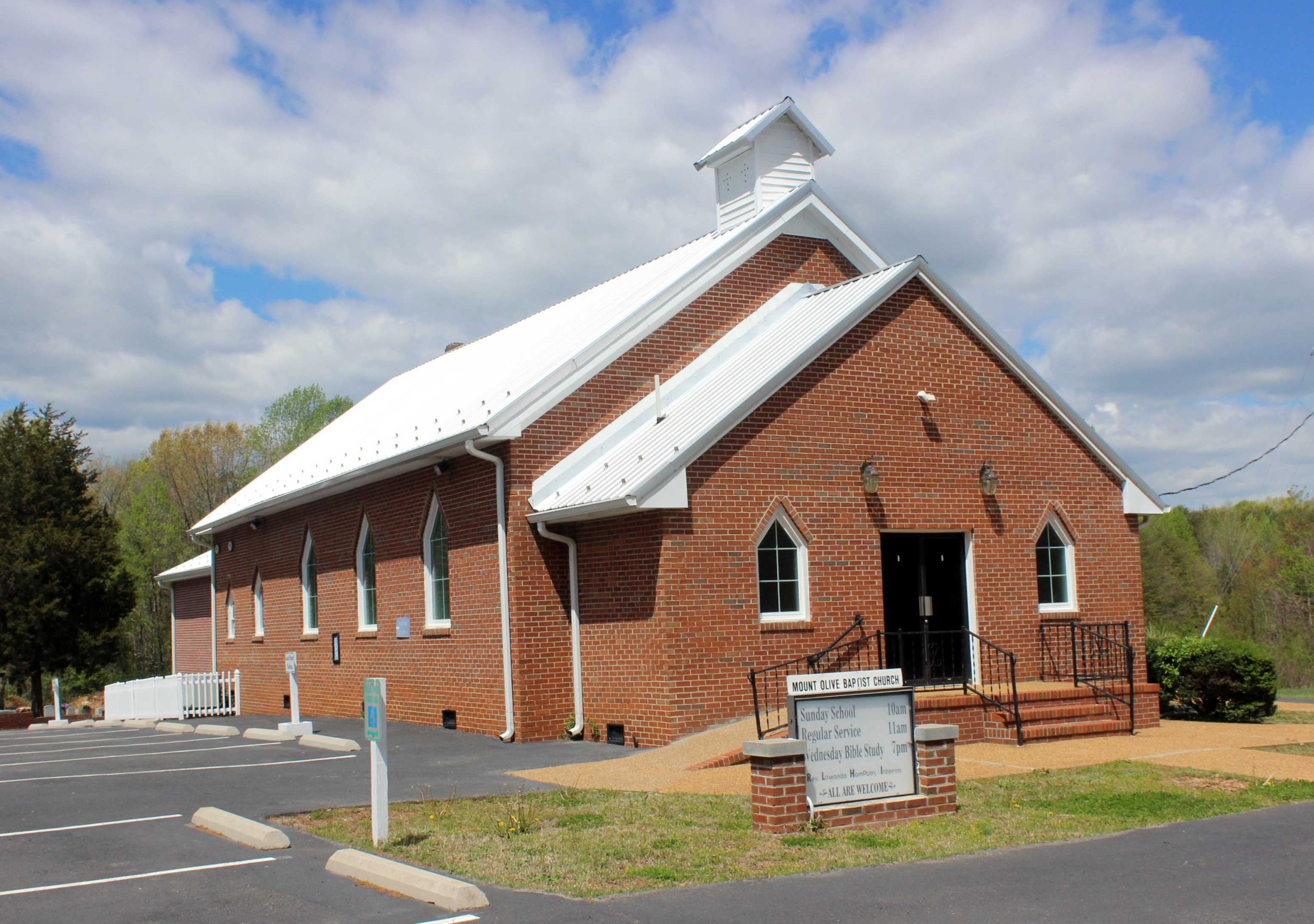 Coleman helped found Mount Olive Baptist Church in 1875 and provided it with a two-acre tract of land. He was also the church’s founding minister, and in June 1882 the county court licensed him to perform marriages. Coleman was pastor of the church until he died. On 27 February 1882 the county court named him to fill a vacancy as justice of the peace. He won election to a full two-year term in May 1883 and served, probably without interruption, for approximately eighteen years. In 1901 the governor appointed him to a four-year term as notary public. Coleman was probably the last African American to hold public office in Cumberland County during the decades after Reconstruction.
Descendants described Coleman as tall and handsome and sometimes as arrogant and haughty. His prosperity allowed him to live in a large, well-furnished house, and his connections with respectable local white businessmen and attorneys helped him insulate himself from the deteriorating political condition of African Americans at the end of the nineteenth century. He spoke out against discrimination and in January 1900 publically opposed a new state law requiring racially segregated cars for railroad passengers.
 Coleman tested the limits of black freedom by marrying three white women in violation of Virginia law. At least twice he wed in Washington, D.C., where interracial unions were legal. On 21 April 1868 Coleman married Martha Catherine Anderson. Following her death on an unrecorded date between 29 February and 23 October 1876, the county court appointed a white male guardian for their two daughters and one son. (A third daughter had died in infancy.) The legal necessity for that court action is unclear, unless the questionable legality of the marriage impaired Coleman’s capacity as father to retain custody of his children. On 30 May 1878 Coleman married Mary Catherine Anderson, who may have been closely related to his first wife. In April 1879 the grand jury issued a presentment against his second wife and alleged that the marriage was unlawful. She died on 24 May, just days before she was to appear in court. Coleman reported his wife’s death as caused by childbirth, although no record was made of the child’s birth or death, and he was accused of poisoning her to avoid a trial for violating the state law. Her body was exhumed, but the coroner found no evidence of poison and a jury exonerated Coleman in June. He later married Wilma, or Wilmoth, Francis Whitlow (known as Willie), another local white woman, who had previously worked in his household as a servant. The date of their marriage is unknown, but it may have occurred about 1889 and certainly before 29
 March 1892, after which she was regularly identified in public records as African American. She may have lived for part of the time in a separate house a short distance from his, although the 1900 census enumerator recorded them as residing in the same household. They had one daughter.
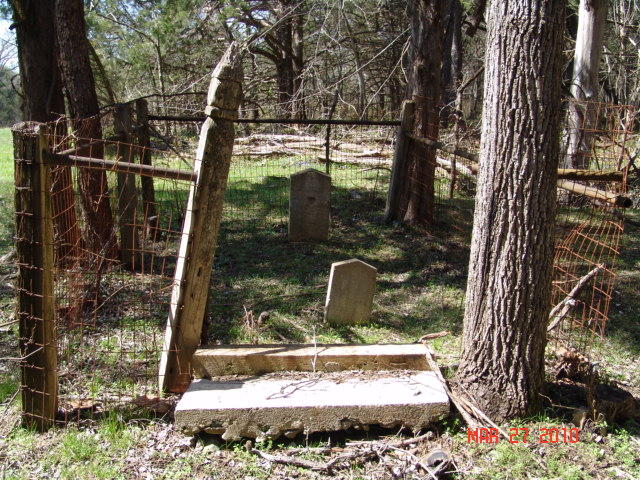
Reuben Turner Coleman suffered a stroke in 1908 and died on 14 February 1909. He was buried on his estate.
