


An enslaved Black carpenter and preacher who led a four-day rebellion of both enslaved and free Black people in Southampton County, Virginia, in August 1831.
Nat Turner’s Rebellion resulted in the death of 55 White men, women, and children before state militias suppressed the uprising. At the same time, 120 Black men, women, and children, many of whom were not involved in the revolt, were killed by soldiers and local mobs in retaliation.
On the evening of August 21–22, 1831, an enslaved preacher and self-styled prophet named Nat Turner launched the most deadly slave revolt in the history of the United States. Over the course of a day in Southampton County, Turner and his allies killed fifty-five white men, women, and children as the rebels made their way toward Jerusalem (now Courtland).
Less than twenty-four hours after the revolt began, the rebels encountered organized resistance and were defeated in an encounter at James Parker’s farm. Following this setback, Turner and other rebels scrambled to reassemble their forces. The next day, a series of defeats led to the effective end of the revolt. White people quickly and brutally reasserted their control over Southampton County, killing roughly three dozen Black people without trials. Within a few days of the revolt, white leaders in Southampton became increasingly confident that the revolt had been suppressed and worked to limit the extralegal killing of Black people. Instead, white leaders made sure that the remaining suspected rebels were tried, which also meant that the white enslavers would receive compensation from the state for condemned enslaved people.
Trials began on August 31, 1831, and the majority were completed within a month.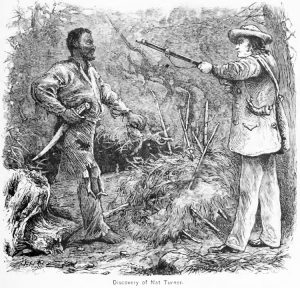 Ultimately, thirty slaves and one free Black man were condemned to death. Of these, nineteen were executed and twelve had their sentences commuted by Governor John Floyd. Turner himself eluded capture throughout September and into October, when two enslaved men spotted him close to where the revolt began. Once detected, Turner was forced to move and was unable to elude the renewed manhunt. He was captured on October 30. While in jail awaiting trial, Turner spoke freely about the revolt.
Local lawyer Thomas R. Gray approached Turner with a plan to take down his confessions. The Confessions of Nat Turner was published within weeks of the Turner’s execution on November 11, 1831, and remains an important source for historians. The revolt had important ramifications outside of Southampton, as southern communities feared additional revolts. In Richmond, Thomas Jefferson Randolph—the grandson of Thomas Jefferson—tried but failed to convince the General Assembly to enact a plan that would have put the state on the path to gradual emancipation. Abolitionists remembered the revolt as an important example of both enslaved people’s hatred for the system of slavery and their bravery. The cultural legacy of the revolt is still vibrant; the revolt remains the clearest example of overt resistance in the United States to the system of slavery.
Mary Richards Bowser was a formerly enslaved woman who became a Union spy during the American Civil War, operating under the cover of a dim-witted enslaved servant in the Confederate White House. Born around 1840–1841 in Richmond, Virginia, she was enslaved by the Van Lew family, whose daughter, Elizabeth Van Lew, an abolitionist and spy, arranged for her to be educated in the North and later sent to Liberia as a missionary. After returning to Richmond in 1860—illegally, under Virginia law—she married Wilson Bowser and was recruited by Van Lew to infiltrate the Confederate capital.
She posed as an illiterate servant in the household of Confederate President Jefferson Davis, using her photographic memory and the assumption of ignorance to access sensitive documents, eavesdrop on meetings, and pass critical intelligence to Union forces. Her actions are believed to have contributed to Union military successes, including aiding in the escape of Union prisoners from Libby Prison.
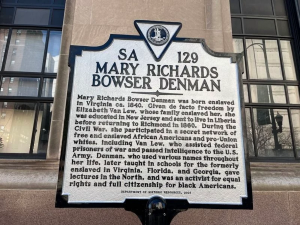 After the war, Mary Bowser continued her activism, teaching at Freedmen’s schools in Virginia, Florida, and Georgia, and speaking publicly under aliases like Richmonia Richards and Richmonia St. Pierre. She advocated for equal rights and full citizenship for African Americans. Despite her documented contributions, much of her later life remains unknown—she disappears from historical records after 1867, with no confirmed details about her death or final years. Her legacy is now recognized as a pivotal example of Black resistance and intelligence work during the Civil War.
Army Sgt. William H. Carney earned the honor for protecting one of the United States’ greatest symbols during the Civil War — the American flag.
Carney was born into slavery in Norfolk, Virginia, in 1840. His family was eventually granted freedom and moved to Massachusetts, where Carney was eager to learn and secretly got involved in academics, despite laws and restrictions that banned blacks from learning to read and write.
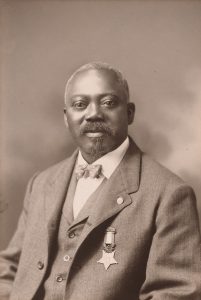 Carney had wanted to pursue a career in the church, but when the Civil War broke out, he decided the best way he could serve God was by serving in the military to help free the oppressed.
In March 1863, Carney joined the Union Army and was attached to Company C, 54th Massachusetts Colored Infantry Regiment, the first official black unit recruited for the Union in the north. Forty other black men served with him, including two of famed abolitionist Frederick Douglass’ sons.
Within a few months, Carney’s training would be put to the ultimate test during the unit’s first major combat mission in Charleston, South Carolina.
Charge on Fort Wagner
On July 18, 1863, the soldiers of Carney’s regiment led the charge on Fort Wagner. During the battle, the unit’s color guard was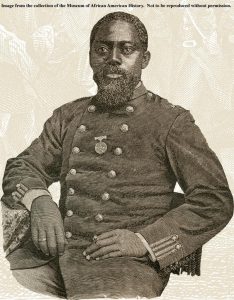 shot. Carney, who was just a few feet away, saw the dying man stumble, and he scrambled to catch the falling flag.
Despite suffering several serious gunshot wounds himself, Carney kept the symbol of the Union held high as he crawled up the hill to the walls of Fort Wagner, urging his fellow troops to follow him. He planted the flag in the sand at the base of the fort and held it upright until his near-lifeless body was rescued.
Even then, though, he didn’t give it up. Many witnesses said Carney refused to give the flag to his rescuers, holding onto it tighter until, with assistance, he made it to the Union’s temporary barracks.
